
Showing posts with label p-jim. Show all posts
Showing posts with label p-jim. Show all posts
Wednesday, 9 December 2009


Monday, 16 November 2009
Can't you see I'm a fool in so many ways?
[Soundtrack]
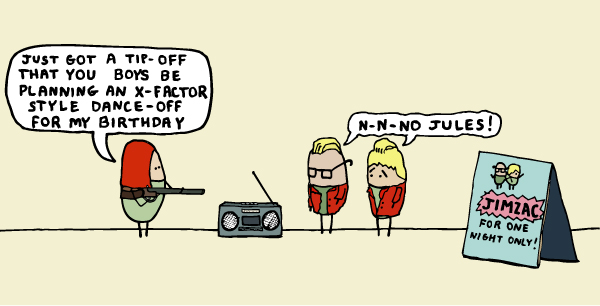
I have yet to actually watch an episode of X Factor from start to finish. That said, even I can spot two off-key twonks a mile off. And this time, even Hitler agrees with me.
[Birthday card for Juliet. Happy birthday Jules.]
Tuesday, 18 August 2009
I used to be a terror but now I am a tired man

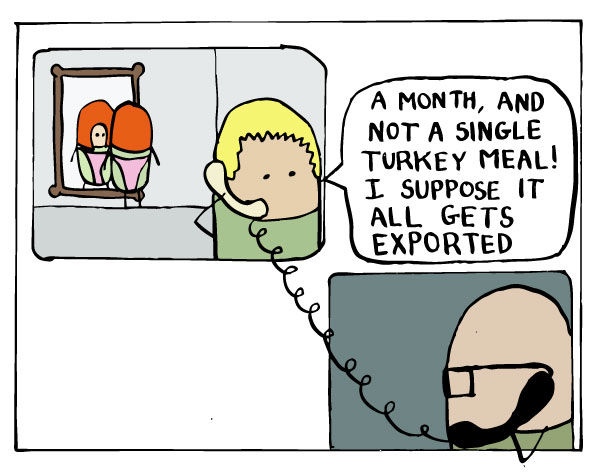
Frute tells me that America doesn't have Jelly Tots.
And you call yourself a 'First World' nation?!
Tuesday, 9 June 2009

Tuesday, 5 May 2009

Thursday, 16 April 2009

Thursday, 9 April 2009
The nature of love

In 1957 Harry Harlow devised an experiment designed to take a pop at psychoanalytic drive theories of bonding ("Mummy gratifies my hunger. I love Mummy"). He wrote up his findings in a paper bearing the tongue-in-cheek title The Nature of Love.


The infant monkeys showed a clear preference for the cuddly mothers, clinging to these surrogates for 18 hours a day (as they would to a real mother) even though they were fed exclusively from the wire mother and even ‘punished’ with sudden blasts of compressed air as they clung to the cloth stand-ins.
Sunday, 29 March 2009

Tuesday, 10 March 2009

Tuesday, 3 March 2009
Spot the difference

[Soundtrack]
"When a gentleman and his girlfriend of two or three weeks are facing one another, phases of lively social interaction occur, alternating with phases of disengagement. Each phase of interaction begins with initiation and mutual greeting, builds up to an animated interchange comprising facial expressions and vocalizations, during which the girlfriend orients towards her beau with excited movements of arms and legs; then her activities gradually subside and end with the woman looking away for a spell before the next phase of interaction begins.
Throughout these cycles the girlfriend is likely to be as spontaneously active as her boyfriend. Where their roles differ is in the timing of their responses. Whereas a girlfriend’s initiation and withdrawal from interaction tend to follow her own autonomous rhythm, a sensitive boyfriend regulates his behaviour so that it meshes with hers. In addition he modifies the form his behaviour takes to suit her: his voice is gentle but lower pitched than usual, his movements slowed, and each next action adjusted in form and timing according to how his girlfriend is performing. Thus he lets her call the tune and by a skilful interweaving of his own responses with her creates a dialogue.
Your attitudes are platitudes

[Soundtrack]
Am trying to decide whether to continue lettering by hand or do it (neatly but laboriously) on Illustrator [see above]. Preferences?
Friday, 23 January 2009

Tuesday, 20 January 2009
A little warm death won't hurt you none

[Soundtrack]
If like Jim you're still suffering from the 'Blue Monday' come-down, apart from a little warm Cassandra Wilson, may I suggest this book I'm reading at the moment: life-affirming stuff.
Wednesday, 31 December 2008
Wednesday, 24 December 2008
Monday, 22 September 2008
Somebody kill me please

[Soundtrack]
"We both know that love will die at last, turn tepid and perfunctory, decline into mere companionship and affection, if there is not cruelty in it. Not physical harm or violence, but cruelty. The cruelty of loss. Of dread. Of jealousy. Whatever the counselling professions tell us about trust, where we are not jealous, we are not in love at all. Othello was within his rights, though it is not fashionable to say so, to claim he loved too well. His mistake was not to see that suffocating his wife was not the best way to express it. Inviting Cassio to his bed would have been the infinitely preferable option for all parties."
(Howard Jacobson, The Act Of Love, p285)
Tuesday, 2 September 2008

Monday, 1 September 2008

Saturday, 30 August 2008
Who needs the perfect girl or boy?
[Soundtrack]
"We possess, as it seems, a certain amount of capacity for love -what we call libido...directed towards our own ego. Later, though still at a very early time, this libido is diverted from the ego onto objects, which are thus in a sense taken into our ego. If the objects are destroyed or if they are lost to us, our capacity for love (our libido) is once more liberated....But why is it that this detachment of libido from it objects should be such a painful process is a mystery to us....We only see that libido clings to its objects and will not renounce those that are lost....Such then is mourning."
(Freud, On Transience, 1915)
Friday, 29 August 2008
Subscribe to:
Posts (Atom)